
INTRODUCTION
Like most children, I grew up fascinated by space. Through some combination of early science classes spent learning about the solar system, trips to a local planetarium digitally exploring the stars and planets, playing with space themed toys, and a lucky video interview with astronauts on the International Space Station, thinking about space played a key role in my upbringing, as it does for many other kids. For a lot of people, this interest in space tends to wane as exposures to the cosmos are no longer readily presented through formal education. But for me, the interest never went away. It seemed that in every stage of life, happenstance situations brought me closer and closer to the cosmos, eventually leading me down a path of more deliberate familiarity with the grandeur of space, and into the fascinating (and expensive) world of deep sky astrophotography. This is the story of how my love of space developed into what it is today, and why I’m glad it did.
View the updated astrophotography gallery here!
As I moved on from high school –perhaps the last time standardized educational curricula provide exposure to outer space– and continued through college, my extracurricular interests seemed to all have some thread of topical connection to outer space. As I followed technological developments of all sorts I was made aware of Tesla, then Elon Musk, and then SpaceX, whose activities gave me ever grander missions and launches to follow. As I became evermore interested in cinema, about halfway through college Christopher Nolan directed Interstellar, which became my favorite cinematic experience and sent me walking out of the theater speechless and awe-struck. As I became more and more enthralled by photography, I learned that you could point a camera toward the night sky and capture long exposure images to bring out the faintest of deep sky objects. All of these things continued growing my affinity for outer space as I continued into medical school, where additional opportunities presented themselves.
I lived about ten minutes away from the National Museum of the United State Air Force on Wright Patterson Air Force base as I completed my medical training. Whenever I needed a bit of an escape, I’d walk through the massive hangars full of aircraft from all eras of aerospace exploration. Sometime near the midpoint of my training, the museum opened a fourth hangar in which they’d created a replica space shuttle, displayed a launch fairing from United Launch Alliance spacecraft, and had several interactive exhibits allowing you to virtually explore Mars and attempt to land a space shuttle. This fourth hangar quickly became my favorite. Outside of the museum, SpaceX was still at it, successfully landing two rockets side-by-side during the launch of Falcon Heavy. The Martian came out. And with a few more dollars at my disposal (thanks to the lump sum funding of student loans) I could finally purchase a camera with enough functionality for long exposure photographs, leading to my first pathetic attempts at astrophotography.


Photos of the Space Gallery at the National Museum of the US Air Force, borrowed from the museum’s website linked here. The remaining two photos are my first cringeworthy attempts at astrophotography through the light polluted skies over Ohio.
In my final year of medical school I traveled to away rotations all over the country (see the collection of those adventures here). And one of my month-long stops was Tucson, Arizona. Tucson is a dark sky city, which quickly becomes evident if you ever have to drive during the night. A relatively paucity of street lights means that some roads even have separate speed limits for day and night. Even in the heart of the city, I saw more stars in the night sky than I’d ever seen before. On one of my free weekends I went on a little adventure to Kitt Peak, about an hour west of Tucson. This was before the COVID pandemic and a wildfire altered the national observatory’s visitation policies. I spent the day walking the grounds of this observatory, or rather, collection of observatories, complete with more than a dozen optical telescopes and two radio telescopes. You can see all the photos from this jaunt here. The facilities were as they should be: geared toward research with no influence from commercialization or tourism. I found every one of the telescopes we toured fascinating, but perhaps the most awe-inspiring was the McMath–Pierce solar telescope, which the Apollo 11 astronauts used to study the moon. They’d even signed a logbook which was on display. Spending the day surrounded by such significant space-focused equipment and lore served as a giant leap in my desire to further explore the cosmos myself. I even worked out a deal with my girlfriend (now wife), that if I matched for residency at the University of Arizona, she’d buy me tickets to a weekend night viewing experience on the mountain.


Photos from my tour of Kitt Peak National Observatory
After my summer of adventure for away rotations, I embarked on a five day road trip back to Ohio. Along the way, I found myself driving through the Mojave Desert in the dark of night. And with little to light pollution, as I looked out my windshield I could see the equator of the Milky Way galaxy clearer than I ever had. My gas tank was so low that my range estimate simply said “low” (you can watch the film of this whole experience here), but I still took the time to pull off the side of the road, stare up at the sky in wonder, and make another pathetic attempt at astrophotography. The picture turned out terrible, but I continued down the road in a state of internal overwhelm trying to grasp the significance of what I’d just seen.
I continued into my first year of residency, long days in the hospital for weeks and months on end broken up by a couple backpacking trips I’d planned to keep myself sane. The first was a trip into the Rocky Mountains, and the second was a rim to rim to rim trek across the Grand Canyon. And on both of these trips, I tried my hand at astrophotography again, remembering to turn off my in-body-image-stabilization before capturing my images. The results this time were a little more satisfying.

Another pathetic attempt to capture a nightscape pulled off the side of the road in the Mojave Desert. I only had about one minute to try to capture this photo; with my gas tank below empty we were in a somewhat urgent need to keep moving. In retrospect, I forgot to turn off my in-body-image-stabilization…


Two slightly more successful attempts to capture nightscapes, the first from Rocky Mountain National Park, and the second from the bottom of the Grand Canyon. Looking back on them, I’m unimpressed, but they’re a part of this story.
The time eventually came to move across the country to Tucson. I’d ended up matching at the University of Arizona (meaning my then fiance, now wife, indeed owed me a ticket for a night time viewing session on Kitt Peak). We’d bought a house about twenty minutes from the city; light pollution was minimal and I had access to Bortle class 3 skies from my backyard. But aside from a bit of stargazing my interest in space languished for about a year and a half while I started my diagnostic radiology residency and planned a wedding.
It wasn’t until our honeymoon that my affinity for space was re-ignited, and in grand fashion. Kitt Peak discussed earlier is one NOIRLab’s (the US national center for ground-based, nighttime optical astronomy) designated sites. Another sits at the top of Mauna Kea, a volcano on the Big Island of Hawaii. Fortuitously, our honeymoon consisted of two weeks on the Big Island of Hawaii. About halfway through our trip, we toured to the near 14,000 foot summit of Mauna Kea and sat above the clouds next to several world-class observatories to watch the sunset. And then, as if simply being in the presence of these majestic metallic domed structures wasn’t enough, we spent the night viewing the night sky from an 11” Celestron telescope (you really should check out the full photographic narrative of this experience here). I’ll never forget my first optical view of Saturn. As it sat in the eyepiece of the telescope, we could clearly make out its rings. It provided an instant perspective shift as I was reminded just how small and insignificant we, and our problems, really are in the grand scheme of things. And as my mind continued reeling from this optical view of such a far off object, I again tried my hand at some nightscape astrophotography. Now armed with a full frame sensor camera in an environment with essentially no light pollution, I was more successful than I’d ever been. More than any experience ever had, these four hours on top of Mauna Kea made me long for continued exposure to the cosmos. And as we drove down the mountain at the end of that night, I knew I’d soon buy my own telescope and start the next chapter in my exploration of the cosmos.


Views from a truly unbelievable, and in some ways life changing, night atop Mauna Kea. Clearly, my most successful attempt at capturing the equator of the Milky Way yet.
Nearly a year went by as I researched telescopes, equatorial mounts, guide cameras, cooled deep sky cameras. Bhatinov masks, etc. between weeks of night call and continued long hours in the hospital. In the course of my research, I kept coming upon the company Starizona, famous for their Hyperstar optics that attach to the front of Schmidt–Cassegrain telescopes. From the name, I knew the company was likely based in Arizona, perhaps in Phoenix given the size of the metropolis. However, when I finally looked at Starizona’s website, I was thrilled to learn that it was instead about fifteen minutes from my front door. I visited Starizona’s store a few times and talked with the incredibly knowledgeable staff about what I wanted to accomplish with my telescope setup, and eventually attended one of their once-monthly outdoor viewing sessions in their front parking lot. At this point, I was in deep. There was no turning back. The past year of research had made me numb to the pricing of all of the equipment; throughout that time I’d gradually increased my budget to the point that I was prepared to skip the “beginner” phase (at least with regard to equipment) and go straight to purchasing something I felt I could grow into over the coming years. After all, what’s the point in working hard to better your life and the lives of others around you if you never actually start enjoying the fruits of your labor? At this point, I just needed a trigger –some occasional that would make me pull the trigger on my high-four-figure purchase. Luckily, my 30th birthday came right on queue, providing all the excuse I needed. One day before my birthday in 2023 (because Starizona isn’t open on Sundays) I walked into Starizona and bought the entirety of what I needed to start viewing and photographing the night sky from my backyard: A Celestron C8 optical tube assembly, ZWO AM5 strain wave geared equatorial mount, carbon fiber tripod, 120mm guide scope and camera, a ZWO 533mc deep sky cooled camera, and an ASI Air Plus.
My initial nights of backyard space exploration consisted of simply peering through the visual eyepiece for long periods of time, recreating that initial viewing of Saturn from the top of Mauna Kea, and seeing the red spot of Jupiter and its moons. I snapped a few photos through the eyepiece on my phone, and honestly was pleasantly surprised with the quality. I was also surprised to learn that I could see the equator of the Milky Way from my backyard just as well as I had in the Mojave Desert a few years prior.
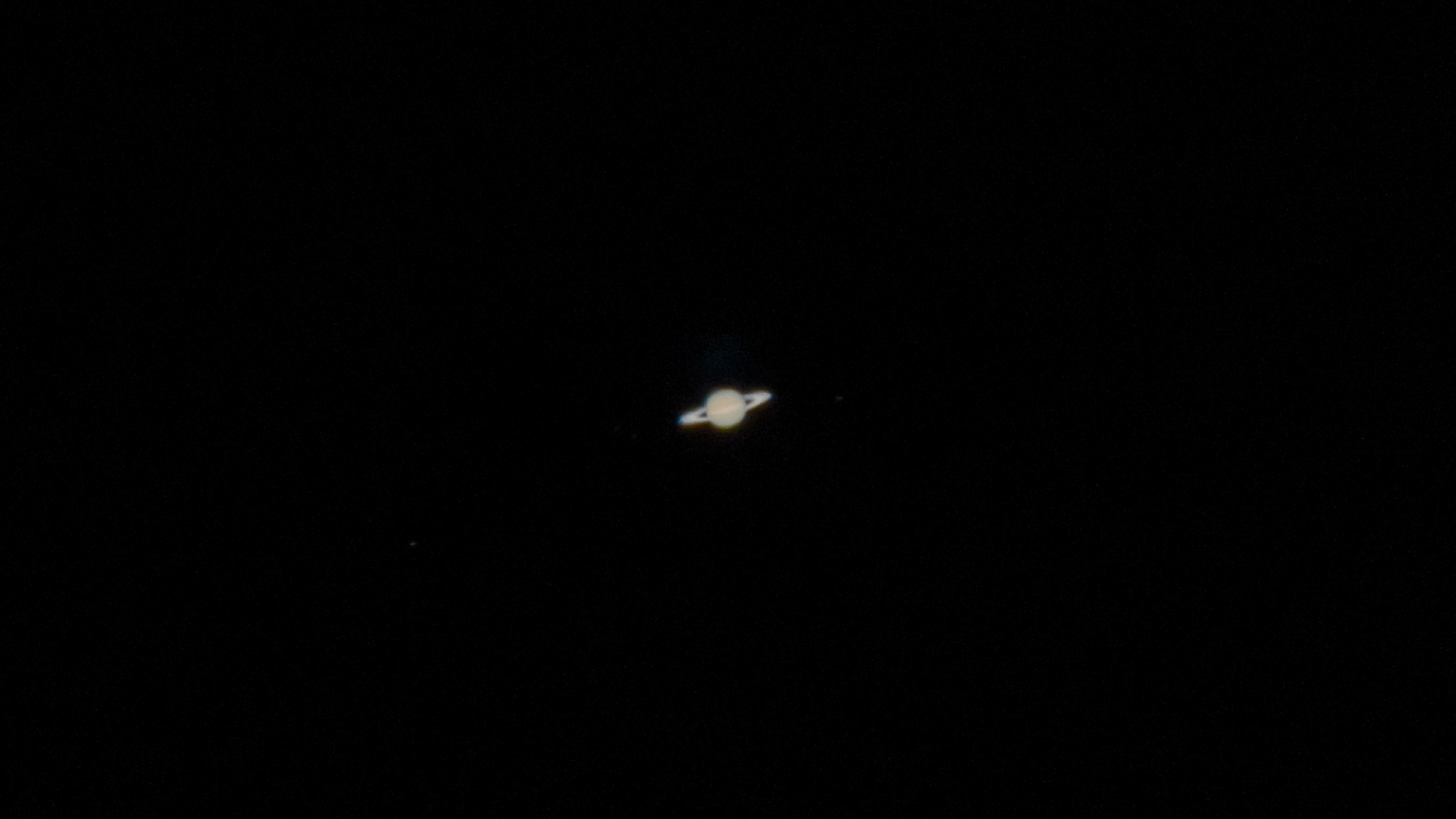


Of course, the first thing I looked at was Saturn. These photos of Saturn and the Lunar Surface were simply captured using my iPhone through the optical view piece of the telescope. And the final photo is another nightscape of the Milky Way equator with cars illuminating the road.
The time then came to start capturing some real astrophotos. I screwed my dedicated astro camera to the back of the scope (no Hyperstar just yet) and took to the skies. After a quick polar alignment, the ASI Air guided my scope to the Fireworks Galaxy, and with my autoguiding turned on, I captured an hour and a half of data on it one night after work. That weekend I installed PixInsight (the standard for astrophotography processing) and began post-processing my first deep sky object, thankful for my years of photo and video editing to help me up the otherwise steep learning curve. The final result was actually something I was quite happy with.

My first deep sky astrophotograph: The Fireworks Galaxy
I was hooked. Over the following three weeks I stalked the Astropheric app to see where clear skies would present themselves (thankfully almost every night in Tucson) and set out to capture as many deep sky objects as I could. And along the way, in another miracle happenstance scenario, as I was setting up my telescope one night I looked in the sky and saw a greenish-blue haze radiating out from a single point coursing across the sky. I had no idea what it was, but snapped a few photos, and later found out that it was the Victus Nox launch for the Space Force from California!

A five second exposure of the Victus Nox Space Force launch, taken frantically after running inside for my camera and tripod. As I was setting up my telescope for a night of astrophotography, I looked up in the sky and saw this strange phenomenon. I’m still in disbelief that I happened to catch it.
All told, over this three week period I was able to image the Pillars of Creation, Helix Nebula, Lagoon Nebula, Triangulum Galaxy, and Swan/Omega Nebula, along with a mosaic of the Moon. Including editing, the combination of these photos represent about 24 hours of my time, but of course, I think it’s time well spent. Capturing these photos draws me out under the star lit skies of southern Arizona on perfectly crisp nights, contemplating our place in the universe. I’ve been able to continue my journey of familiarity with the cosmos, and am able to do so from my own backyard. And perhaps the most exciting thing is that, after a lifetime of growing imperceptibility closer and closer to outer space, this new chapter is only the beginning of what is sure to be a long and enjoyable adventure.
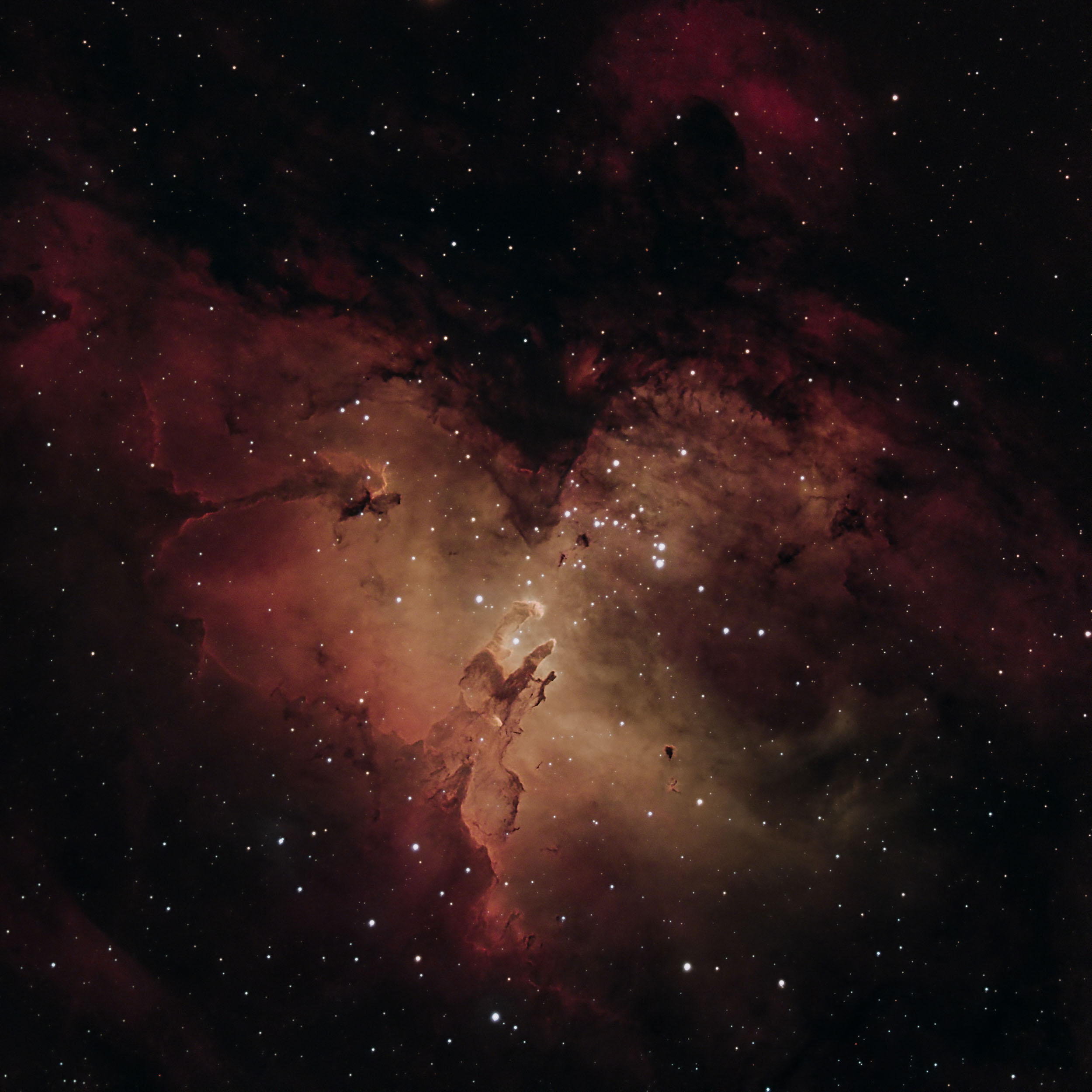


In order: Eagle Nebula/Pillars of Creation, Lagoon Nebula, Helix Nebula, Triangulum Galaxy, Omega/Swan Nebula, Moon